5 January 2017 by Jennifer
Seven steps for building a new habit of more movement/exercise – or indeed a different new habit. All-size-friendly.
Building new habits is an area I’m interested in, and I thought this would be a good time for sharing some of what I know and/or think about it.
Some of this will be relevant to any new habit. Could be writing, or practising a skill, or making things. But I also wanted to talk about movement & exercise in particular – without “weight loss talk”, and acknowledging that our own choices are only part of the bigger picture of our health.
Health is not a moral high ground, it is multi-dimensional, never fully within our control, and our prioritization and health path are personal.
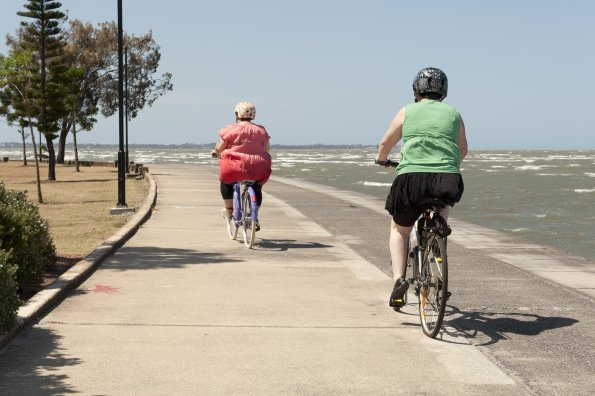
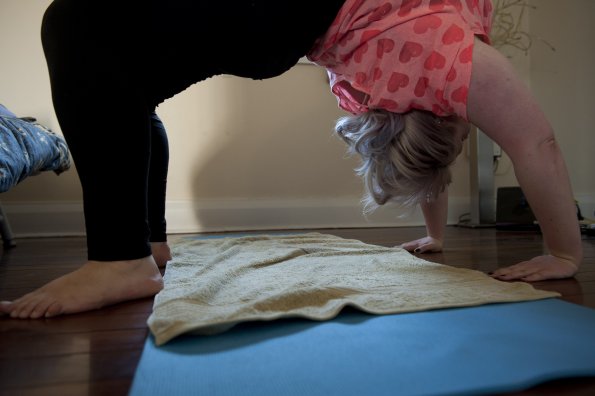
Credits: all the photos on this post are from Stocky Bodies, a resource for non-stereotypical images of fat people.
Disclaimer: I’m not an exercise professional or top athlete, just an ordinary kind of human who sometimes swims, walks or dances, and sometimes accidentally stays sitting at a computer for hours, oops :-) Any use you may make of my ponderings here is at your own risk!
My recipe, for what it’s worth…
Seven steps in summary
-
If possible, find some kinds of movement that you enjoy.
-
Think through your motivation for adding a new habit. Sustainable or flimsy?
-
Shrink the obstacles, as far as possible.
-
Identify specific possible times, and set reminders – even if you don’t want to commit to them all for sure.
-
Ramp up slowly, and don’t overdo it.
-
When it works, celebrate.
-
When it doesn’t work, be curious.
Enjoyment
Step 1: If possible, find some kinds of movement that you enjoy.
-
Preferably more than one, so you can mix it up.
-
Not necessarily something that’s usually thought of as “exercise”. Could be dancing… gardening… distributing leaflets for something you believe in.
I wish they made play-parks designed for adults. Seriously. That’s the kind of moving I actually enjoy.
-
Include tiny things like “stop in the middle of what you’re doing and gently stretch”.
-
If you like the idea of a group thing, try different groups before deciding. The group leader & group culture makes a lot of difference.
-
Sometimes it’s hard to think of any movement you’d actively enjoy, or hard to find an emotionally-safe place to do it. Be gentle with yourself. Maybe there’s a creative way that can still work anyway.
-
Try adding music, audio-books, podcasts or the company of a friend.
-
Laughing uses muscles!
Tip/recommendation: If you have pain that’s originally biomechanical, like an old back injury or sore feet – or just want to avoid those – then maybe check out Katy Bowman‘s books & blog for ideas.
Motivation
Step 2: Think through your motivation for adding a new habit. Sustainable or flimsy?
Weight loss as a motivation: i.m.o. flimsy, and can easily backfire.
If your clothes don’t fit, maybe start following plus size fashion people and save up for some glorious new clothes :-)
So what motivational thoughts would I recommend, when you need one? Maybe one of the following will ring true for you…
-
My favourite, because it’s so simple and immediate: for many (perhaps most) people, movement can give an immediate uplift in mood, which lasts for a while afterwards.
-
Some movement is good for most bodies in the long run. Even just going from “pretty much no exercise” to “a little bit” is worthwhile.
-
It’s good for your brain.
-
You could include movement in what you’re doing anyway – like walking for an errand.
-
It could go along with contributing to your community, e.g. something like your local Wildlife Trust.
-
You can include meeting a friend. Even if the friend doesn’t want to do the same thing as you, you could meet them afterwards.
-
You could walk a dog, if you like dogs.
-
You can set yourself a challenge, like learning a dance or taking part in a communal walk or run… or any ambition that gives you a zing of enthusiasm.
-
You might enjoy it :-)
Smoothing your way
Step 3: Shrink the obstacles, as far as possible.
To actually go and do the thing, your motivation has to be bigger than the obstacles.
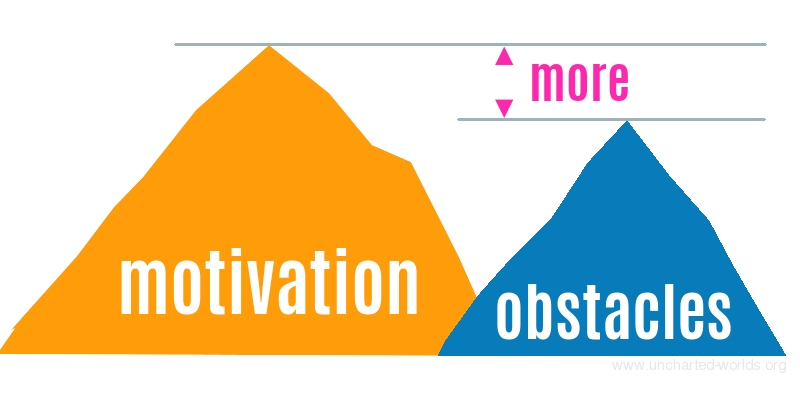
One side of that is tuning in to your motivations – as in the previous section.
But some days, your motivation might still feel pretty tiny! So the flip side is to solve or shrink the obstacles, as much as you possibly can.

What do I mean by obstacles, and what can you do about them?
Some practical obstacles are obvious, like not having a swimming costume. (Tip for writing down tasks.)
Some practical obstacles can’t necessarily be 100% solved – only gradually explored. For example, if you have pain, fatigue or a past injury, it might take a while to figure out which kinds of movement are good for you.
Some obstacles are more about feelings. Those need gentle, compassionate attention, accepting how things are for you right now.
Here, though, I especially want to shine a spotlight on the type of small and subtle obstacles which may trick you into thinking they won’t matter!
-
You wake up in the morning intending to start your day with a little walk… and you’re wondering whereabouts in the house you left your comfy shoes.
-
You’re not sure what time the pool opens next.
-
You were going to dance, but the stereo’s still unplugged from when you had to move it the other day.
Some days, this size of obstacle would be like nothing. But when you’re a bit tired already, these pesky little bothers can tip the balance, and end up making the difference between doing the thing and not.
I want to point to the power of leverage that’s available from creatively smoothing your own way in advance. It’s an amazingly accessible way to boost your chances of following through. For the best chance of a new habit, take the time to smooth out all the obstacles you possibly can. That’s much more sustainable than relying on willpower to overcome them.
Putting things ready in advance is like a present, from the you of now to the later you who’s gonna do the mission.
This goes for both practical things like clothes or music players, and finding out information.
For example, I have one particular bag that I only use when I go swimming, and my swimming things go back into it when they’ve dried off, ready for next time.
Give yourself abundant permission to tweak tiny details to support the future you. It isn’t overkill if it helps!
In the ideal world of smoothing the way, what you want is: when it’s time to go and do the thing, the only thing stopping you is the energy required to start moving.
Times and reminders
Step 4: Identify specific possible times, and set reminders – even if you don’t want to commit to them all for sure.
Imagining ahead to specific times and places primes your brain so you’re more likely to do the thing when the time comes.
The plan doesn’t necessarily have to include a “clock time”. Sometimes you can build in your new habit by linking it to another activity. For example, “Right after my first cup of coffee in the morning, I’ll put some music on and dance around”.
It doesn’t necessarily have to be a commitment or promise (though some people might prefer that). This stage could just be
-
imagining yourself doing the thing,
-
thinking of a possible good time for it, and
-
setting a reminder (e.g. a popup on your phone, or putting your favourite coffee mug next to your music player).
Slow and steady
Step 5: Ramp up slowly, and don’t overdo it.
A common mistake for people starting a new exercise habit is to do too much the first time, and end up achy for a week, or even injured.
Avoiding that kind of setback is a good reason to start small and gentle with a new activity.
Beware exercise classes where the class leader is all gung-ho for people to push themselves. I like the ones who, instead, remind you to check in with your body.
Besides, you might want to focus initially on building the new habit, rather than on reaching some particular level or doing some particular distance or amount. For example, the beginning of a new walking habit could just be a few moments in the open air.
Everything counts
Step 6: When it works, celebrate.
If you did it, give yourself credit!
Maybe all you did this time was put your shoes on and step outside for a minute. But you did a new thing. That counts.
Compassionate troubleshooting
Step 7: When it doesn’t work, be curious.
Sometimes you’ll fail to do the thing, even though you meant to.
If you didn’t do the thing, trust that there was a reason – a “good reason”, that doesn’t imply being harsh to yourself about it.
Don’t put yourself down with words like “lazy“.
Use your curiosity to discover what’s going on in the interaction between you and the world. Look for what you need, in your own unique circumstances, to make things work.
-
Is there something practical that you’d want to tweak for next time?
-
Are you tuned in enough to some reason(s) for bothering?
-
Would it work better to “start smaller”?
-
Are you feeling bossed around by society telling you “Do it!” and you’re healthily rebelling by not doing it?
-
If you tried a class or meetup and didn’t like it, was it the activity itself you didn’t like, or was it more the group or the leader or the place?
-
Are you so tired that you actually need sleep more than you need this new habit right now?
-
Are there friends who could support you in some way, e.g. by joining in, or meeting up at the end of a walk, or ringing you to encourage you at a specific time?
-
Do you need to gracefully extricate yourself from some other commitments so as to give yourself more time and energy for the new adventure?
Whatever’s in your way, be compassionate to yourself, use your curiosity to find out what’s happening, and use your creativity to shrink the obstacles.
Good luck!
And here for extra inspiration is a lovely 1-minute video featuring Dianne Bondy: