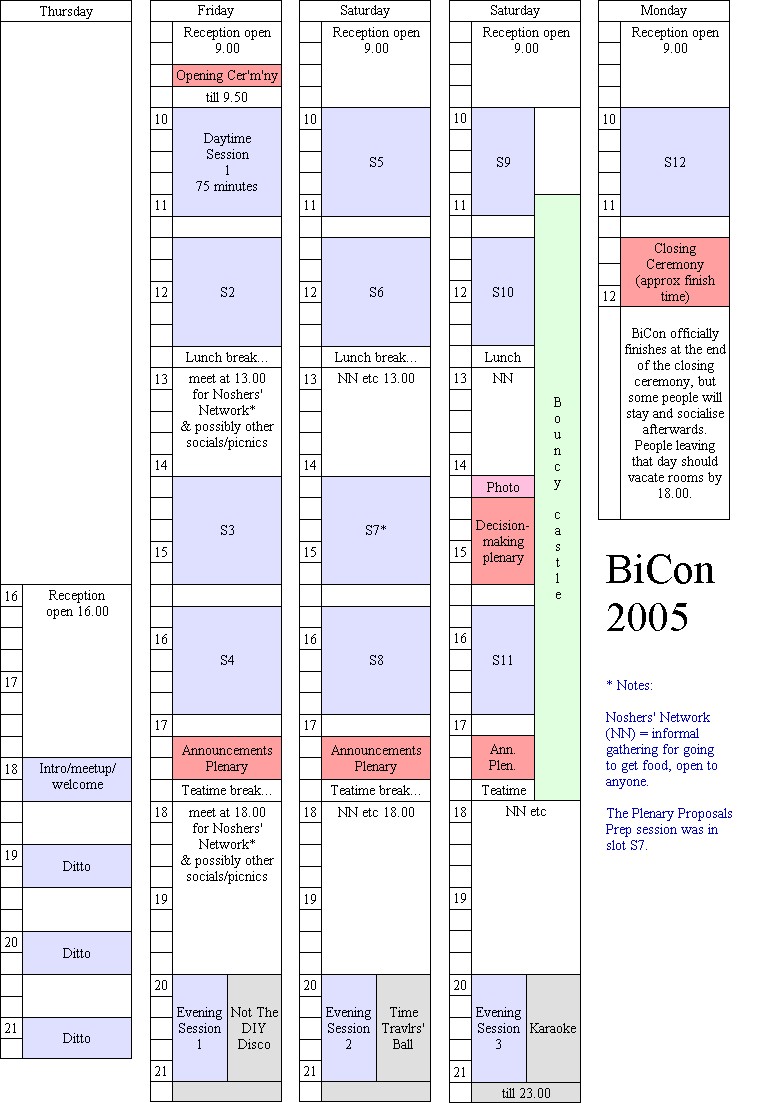

In the run-up to BiCon 2005, I was keen to get my head around the variables in BiCon timetabling, and its history, so as to learn from the past and not "reinvent the wheel". I looked through the programmes for the BiCons I'd been to, and borrowed a couple of older programmes as well.
To be able to grasp the pattern of the structure, and compare year to year, I felt the need of some kind of consistent visual representation, scaled for time. So I did some pretty pictures in SmartDraw.
Really I did them for me to print out, so I could compare them easily. So they're laid out to fit nicely on A4 paper, and not that well optimised for viewing on a screen. Plus, as their purpose was to gain an overview of the pattern, it didn't matter that it's not very easy to see on this layout exactly what times individual things happened. But for what they're worth, here are some JPEGs (each one around 100k to 160k):
1994 1995 1996 1997 1998 2000 2001 2002 2003 2004(1999 is missing because I didn't go to that and didn't have a timetable of it to hand. I didn't go to 1994 either, but was lent the programme. I also had the programme for 1993, but never got around to doing the pic for it.)
Having mulled over those structures, and my memories of the BiCons they represent, I did a similar pic showing my ideas for 2005. We did change it slightly (my original draft had the closing ceremony after lunch, with an additional workshop session on the last morning), but most of it survived to become the BiCon 2005 timetable, shown here in a similar format for comparison (181k).
I also wrote some explanation for the team of why my favoured structure looked as it did, which follows here.
based on a couple of posts I made to the BiCon 2005 team discussions, in May 2005 when we were in the middle of planning.
Workshops all the same length, with the possible exception of the evening ones. This keeps the scheduling jigsaw simple and means that people running sessions know what length to prepare. Otherwise you have to start matching longer workshops to longer slots and shorter workshops to shorter slots, and that either gets rather arbitrary or rather complicated - let's not go there :-)
Workshops 75 minutes. I'm somewhat open to argument towards 90, 85 or 80 minutes, but not to anything shorter than 75. If they're too short, the end of the workshop comes just as you're "cooking". 90 minutes is a nice length of time for a workshop, but timesed by four it adds an hour to the day
80 or 85 minutes would be arguable, but people tend to "think" in quarter hours and we seem to have aligned on 15-minute breaks. I.m.e. odd five minuteses here and there tend to make the times harder to keep clear in the mind.
[Note that the 15-minute breaks were based on the nearness of the accommodation blocks. For reasons of accessibility, further-away accommodation implies longer breaks. If we had needed, say, 25-minute breaks, then I might well have argued for 80-minute workshop sessions, to keep as many start times as possible "on the hour"/"on the quarter hour" etc.]
Structure basically similar from day to day. Again, to make it easier for people to keep in their heads what times things start and finish.
Plenaries in the morning: Opening ceremony on the first day is the only morning one I would suggest. I think the opening ceremony can be a lovely exhilarating time, so I definitely think let's have one, and that morning there's a reasonable chance that people will get up in time. Subsequent morning ones are never anything like as well attended, and i.m.o. there is little point in having a would-be plenary which in fact most people don't go to.
Plenaries in the evening: There can be practical reasons for having at least one plenary a day where announcements can be made to everyone at once or problems addressed, but my main reason is not that. I'm influenced by a couple of people who have told me they value the sense of community when we're all in the same room, and that at BiCons which haven't bothered with a daily plenary, it feels like that dimension is missing. When they said that, I thought actually I kind of agree with that myself. There's something about the buzz of coming together after a busy day and looking forward to tonight's ents, which I like and appreciate too.
Decision-making plenary on Sunday, with a structure for the run-up to it which will maximise the chances of a good plenary. [This was done. See the Decision-Making Plenary bit of my BiCon 2005 Report.]
Photo on Sunday, before DMP. Sunday because it's the time when probably most people will be there. Before DMP because it makes sense to combine two things where we want everyone to be there if possible. Also, I would sincerely hope that the DMP would not need 75 mins! So it makes sense in terms of adding up times as well, if keeping a similar structure from day to day.
[Note that BiCon 2005 ran Thursday night to Monday lunchtime. If BiCon finishes on the Sunday, the same arguments would place the photo and DMP on Saturday afternoon.]
Teatimes. Long enough for people to go off site and hang out over food and come back in a leisurely way.
Noshers' Network would operate at every meal break.
Evening workshops. My purpose here is nothing to do with "squashing more workshops into BiCon". [That had been mentioned previously, as "not a good reason to do it".] It's part of taking care of everyone. Not everyone likes free-form bar-oriented chat socialising - they might be shy, they might not know many people, they might not like being around alcohol, whatever. I do not want people lurking alone in their rooms in the evenings because they find the ents/bar environment too intimidating or scary. The quiet room is important, but it still doesn't necessarily help people to meet each other.
I was thinking along the lines of one specifically leisure-ish one each night such as "Learn a little dance routine for fun" (of course that one would lead its participants naturally to the dance floor afterwards :-) ), and maybe also one similar to the daytime kinds of things, with a discussion of some kind. We'd have to make sure that the people running them didn't specially want to be at the rival ents in the early part of that evening.
First-night workshops. Just something to be going on with that enables people not to be on their own, if they're new or if their mates haven't arrived yet. Haven't decided yet what would be in them, but I'm relating to them as something I'll organise under the "welcoming" umbrella. Last one at 21.00, later than the other nights, because if people have driven up after work, they may only be arriving around then. (Hmm though maybe that ought to apply to Friday too. Maybe a bit of surveying on the BiCon LJ would help to get a sense of numbers of when people plan to arrive.)
Bouncy castle: I don't have strong feelings about when that would be. Probably Saturday afternoon, if the photo and DMP are indeed on Sunday. (Though if we did have it on Sunday, we could make the DMP slot kids-only on the castle, assuming any & all kids were with the creche workers at that point rather than requiring parents to miss the DMP.)
Later, following a discussion with Martin:
Closing ceremony before lunch on Monday [rather than after lunch as in my first draft]. This would not be unprecedented, although early-afternoon closing plenaries have been more common. The main advantage of it is that more people would be able to be there and get a proper "rounding-off" of BiCon before they leave to travel home. In a way, it doesn't really shorten the BiCon experience for the people who can stay later, because the Monday afternoon is still available for extra socialising.